

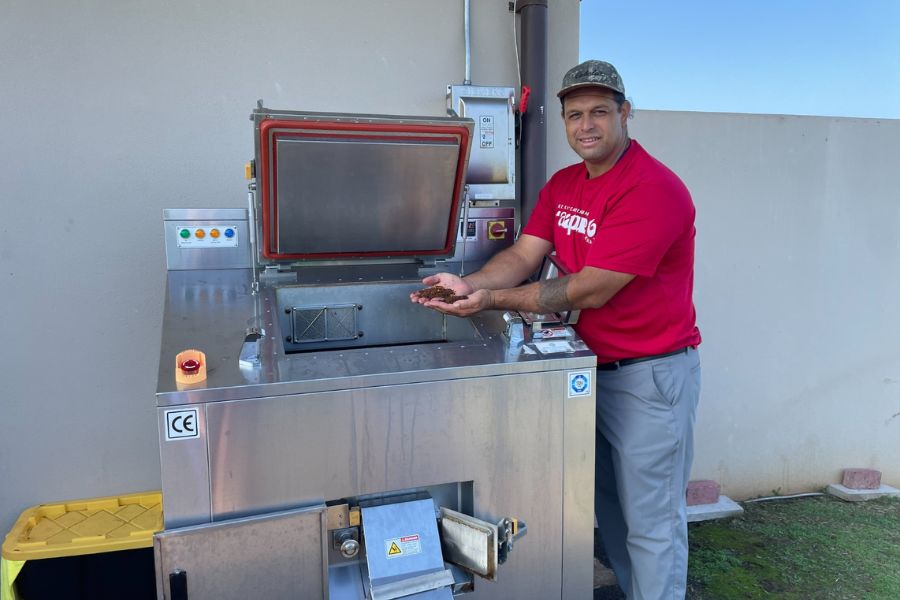
At lunch, hungry students line up and exit Keʻeaumokukapāpaʻiaheahe with heaping plates of food. However, when these students bite off more than they can chew, it warrants a solution. Tucked away behind the dining hall lies a modern composting machine, the remedy to this food waste problem.
There are three machines in total. They occupy the high school, middle school, and elementary campus. These machines are brand-new for the 2025-2026 school year, and they yield educational, cultural and ecological benefits.
Kumu Iwikauikaua Joaquin, the ‘āina sustainability teacher for grades 6 to 12, said the machines contribute to the sustainability of the campus. In the past, food waste would go to various pig farms around the island, but with the addition of the compost machines, the leftovers come back to the school.
“We’ve kind of closed that loop in how our food waste would get taken away, and now it’s staying on campus, and we’re turning it into fertilizer as well as chicken feed and hopefully some pig feed, and then we can get some pigs. The idea is also to be more sustainable about all of our waste,” he said.
Compost is beneficial to the gardens scattered around KSM as it acts as a natural fertilizer. Furthermore, it’s used in the greenhouse for potting soil.
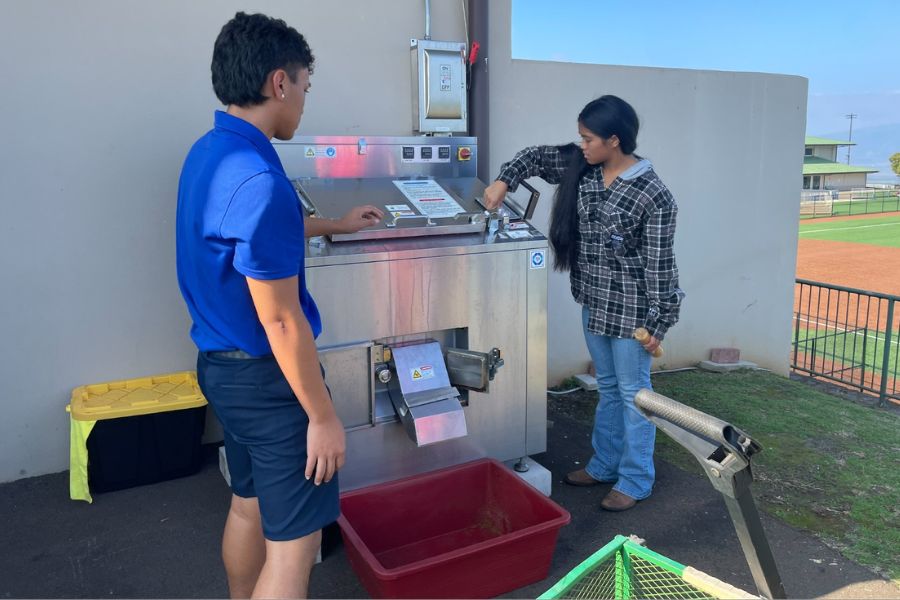
Though the machine looks daunting, this device is essentially a computer. After pressing a few buttons, the contraption will begin to do the work itself.
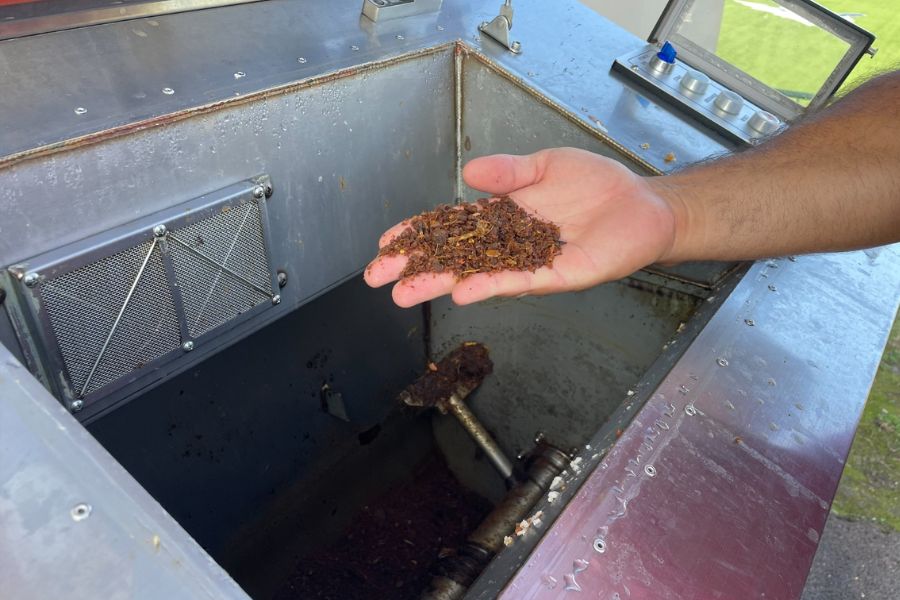
“It senses how much food is in there, it weighs it, and then it starts to turn on when we turn the machine on, and it starts cooking, it’ll heat up to a certain temperature, and there’s paddles in the machine that are turning the food waste to make sure that it cooks evenly. And so at the end, we get this really dehydrated grain consistency,” Kumu Iwikau said.
The machine isnʻt high maintenance. There are only a few steps to ensure it functions properly.
“So the biggest maintenance of it is basically cleaning up wherever the food waste touches. So, I have a spray and a little scrubber brush, and the water hose. It just takes us a few sprays, and that’s about it. Any food waste that falls on the ground, you can pick it up and throw it in, shoot it away, or if it’s finished food waste, we can just brush it into a dustpan, because it’s a dehydrated grain. It’s not much maintenance at all,” Kumu Iwikau said.

Compost isn’t too picky; virtually any food can become nutrients for the soil. Some foods, like coffee grounds, due to their nitrogen content, boost the composting process.
Though many foods can be composted, there are some exceptions.
“We try to stay away from pouring a lot of oil and dairy into the system. And then, orange peels. Our microorganisms don’t like the acidity in orange and lemon peels, so we try to limit that. When we do have a lot of those, we’ll put them in a spot in our garden dedicated to slow decomposition,” Kumu Iwikau said.
The composting process, though simple, takes quite some time for the microorganisms to break down their food. Compost is created daily at KSM, with several piles remaining at different stages of decomposition.
“It takes a long time. We’re turning the compost almost every day or every other day, turning it to ensure that it’s getting oxygen, watering it because the microorganisms also need water, just like us. They breathe air, so we gotta turn it up. And all that energy is what builds up the heat in the pile. We saw that once the pile stops heating up, around the 45-day mark, that’s kind of when you know that they’re not reproducing as much, and not eating as much, which is when you can start to sift through the pile,” Kumu Iwikau said.
Producing compost takes even longer without a machine. Kumu Iwikau emphasizes that, based on how frequently the compost piles are moisturized, it could take 60-90 days to be ready. The new compost machine alleviates the wait time.
In addition, the compost machines allow students to interact with the system and encourage them to delve into concepts of food waste management and sustainability.
“Our haumāna are taking part in this process and being able to see how much food we waste. They’re seeing the food waste come out. They’re becoming more aware of the food they put on their plate, instead of having eyes bigger than their stomach,” Kumu Iwikau said.
The course, Agriculture, involves students in composting through a hands-on approach.
“We’ll go collect it in the morning. And then we combine it with the previously made compost, and eventually it turns into usable compost. This procedure is important so that students know that waste can be eco-friendly,” said senior Naupakapualahaole Olaitiman, an Agriculture student.
The appliance was the ideal implementation for budgeting and maintaining equilibrium for soil nutrients. Kumu Iwikau said that the large machine cost $65,000, while the small machine at the middle school costs around $30,000. Nevertheless, overall, itʻs proved cost-effective because, year ’round, the school spends $2,500 on compost mixed soil a year, making it a worthwhile purchase. (2/17: incorrect information in this paragraph has been updated.)

“Our long term goal is to absorb the cardboard recycling cost of $15,000 a year by utilizing a cardboard shredder to recycle our cardboard on campus as the carbon portion of the recipe in making compost on campus,” Kumu Iwikau added.
“Within the first three years, we grew a good harvest of sweet potatoes and kalo. We harvested all the nutrients made available for those plants. As we started planting more, we realized that the nutrients were low. So we were buying a mixture of compost and soil, by a truckload, and we thought it was an easy fix for us. But as our fourth year approached, we looked at the budget and how we’re spending Pauahi’s money,” he said, “so we wanted to add a different layer to our program–having our students realize that we can make our own fertilizer. We don’t have to buy fertilizer from the store.”
There has not yet been an excessive amount of compost. So far, the projected goal for compost is generate 1 ton of compost each year. Even so, Kumu Iwikau has plans for what may happen if the machine produces too much.
“If we have too much compost, we can offer it to be taken home for families to use,” said Kumu Iwikau. It’s also possible that it could be sold in the future to support student programs, like ʻāina-based excursions.
In the long run, composting highlights the ethical and economical importance of utilizing each and every scrap to its fullest.
This is important because according to a 2015 report by Matthew Loke, professor in natural resources and environmental management, and PingSun Leung , professor in agricultural and resource economics at UH Mānoa, the highest level of food waste in Hawaiʻi in 2010 was equivalent to 26% of Hawaiʻi’s available food supply. In annual terms, that’s 161.5 kg of food waste per person. This food waste was approximated to be worth $1.025 billion at the time.
Kamehameha Maui joins other entities like the Oʻahu Compost Project that seek environmental and sustainability solutions, In 2023, the OCP diverted more than 30,000 pounds of food waste from landfills and incinerators, diminishing carbon emissions by 8.12 tons of CO2eq that would have been released during the burning process.
The overarching goal of this project is to give back to the land. Kumu Iwikau emphasized the importance of giving back to the ‘āina to learn from the mistakes of the past, saying that this practice comes from a traditional Hawaiian perspective: to extract only what can be adequately returned.
“We need to make sure that what we put into the ʻāina is in the best interest, not just for us and the plants, but for the future generations. We have so many examples right around us–the sugarcane, the pineapple, and these big organizations … (that) took whatever they could, and left it in a way that wasn’t the best situation,” he said. “So, we ought to learn from those mistakes and show our students that we can be responsible in what we do, how we do it, and be like our kūpuna.”






Malia • Feb 19, 2026 at 11:49 am
This is super cool and awesome
Kumu Mossman • Feb 14, 2026 at 6:01 am
Interesting. I didn’t realize ksm composted. Very informative article. I enjoyed it AND learned from it. Mahalo.