

Last week I had the opportunity to travel to Aotearoa, New Zealand, to present the Hawaiian children’s book that I and four of my hoapapa (classmates) illustrated, wrote, and self-published. We shared our work at the World Indigenous Peoples Conference on Education, also known as WIPCE, in front of indigenous educators and students from around the world.
Let me tell you, my nerves were going crazy before the presentation. But before I get there, let me rewind a little.
The only flight that worked for us took us to Sydney, Australia, first. So, we made the most of it. We spent the day exploring, visiting the famous Opera House, and wandering around the area.
I bought magnets for my family and, more importantly, candy for myself: The Natural Confectionary Berry Bliss Flavored Jellies. I am not kidding, the candy was the highlight. It’s made in Australia and reminds me of a Gusher, only it’s shaped like a raspberry and way more gummy.
After exploring the city and taking the train, we flew out that night for New Zealand.
The flight to Aotearoa was short, only about three hours, and we landed at night. But when I looked outside at eight in the evening, it was still bright like it would be at four in Hawaiʻi. My first thought was, how do these early birds wake up so early if it still looks like daytime when they are going to sleep? A mystery I will never solve.
The next day was our first day at the conference. It was powerful to see so many respected cultural leaders and knowledge-keepers gathered in one place. As we listened, one thing kept repeating in everyone’s stories: colonization.
Even though all of us came from different places and different cultures, there was this shared feeling of heartbreak, but there was also a shared strength. Being in that space proved how events like WIPCE create unity, empowerment, and cultural growth because we can relate to each other and honor each other’s stories.
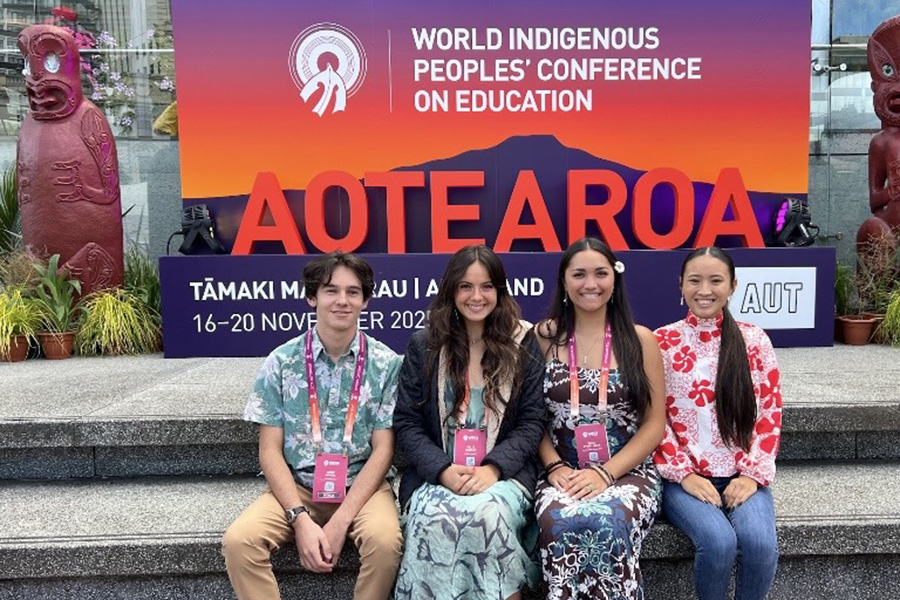
The conference stretched from Monday to Thursday. Every session I attended inspired me and helped calm my nerves as Thursday approached. That was the day I, Sara Stupplebeen, Vann Siphers, and Teija Wada would present.
Let me take a moment to talk about the food. People were complaining, but honestly, I love trying new food. We basically got the same thing every day at the conference, but they always offered lamb or beef sandwiches, so I just switched back and forth. Simple. Delicious.
Then Thursday came. Presentation Day. We were scheduled for 9:30 a.m. in a huge cinema theater. I was the oli kāhea for our chant, No ke ahupuaʻa.
At first, the room was filled with teachers and people from our school and Hawaiʻi. As it got closer to start time, more people started coming in. By the time we started, the room was packed and people were standing in the back because every seat was taken.
We opened strong, sharing where we come from and who we represent. Even though we had practiced to present for a month, we reminded everyone that this project took an entire year to complete.
We talked about how the four of us built pilina, learned each other’s strengths, and literally put them on the pages of our book.
I talked about legacy and how this project helped us revitalize Hawaiian culture in our own way. I connected it to Bernice Pauahi and the legacy she created for Hawaiian children. We are continuing that work by building a foundation for the next generation.
I also shared about the feeling of not being Hawaiian enough.
All of us felt it at the start of this project.
We questioned whether we had the right to talk about cultural revitalization through ancient moʻolelo, but the more we worked, the more we realized that feeling was fake.
The truth is that we have Hawaiian blood. We are kanaka ʻōiwi. We broke that stigma by showing that there is more than one way to live our culture. We were not hula dancers or Kaiapuni kids. Our skin tones varied from light to olive and brown. We were not of the darker skinned, but we found our identity through the power of education and storytelling.
When I said that out loud, the audience applauded. I saw people crying. And in that moment, I realized something I had been searching for for a long time: I am Hawaiian enough.
The presentation ended on such an emotional high. People came up to us, thanked us, and told us they felt hope for the future. I felt honored to be there and to represent my lāhui in another place other than home.
If you asked me in November of 2024 if I ever thought I would feel this grounded in my culture and skin, I would have said no, but working with Kumu Kēhau and Kumu Hulali and doing this project with my friends helped me not only grow as a storyteller but ultimately find myself as a Hawaiian.





Poʻo Cagasan • Dec 11, 2025 at 7:53 am
Mahalo for sharing your manaʻo once again; very powerful. You all did a wonderful job, more so, you realized not only that you belong, but that you all are more than “good enough”! Hoʻomakaʻi!
Poʻo Kapulani • Nov 28, 2025 at 1:19 pm
What a beautiful experience that culminated in the greatest gift you could ever receive – that realization that you belong, not only to the greater ʻohana o ka poʻe ʻōiwi o ka honua a me ka Pākīpika but to your own lāhui o Hawaiʻi nei. Mai poina. He Hawaiʻi ʻoe!