

When I was younger, I felt isolated from the Hawaiians around me because of my queerness. I felt like after I came out, I didn’t belong anymore. There was something different about me.
In our increasingly Christian society, where adhering to a specific set of beliefs and ways of life are held high, I felt out of place. Hawaiians around me told me to repent for my sins (being queer and trans), and that I needed to “seek Jesus.”
I was consistently, constantly excluded at school, called slurs, asked incredibly personal questions (e.g., what’s in your pants?), and faced general disrespect all around. I was terrified to use the men’s bathroom, but would get dirty looks for going into the girls’. It felt like I couldn’t win.
For a long time, I let it get to me. I sank deeper into my hoodie, became depressed, and even considered ending my life. Then I learned about a single word that changed my life: māhū.
When I watched Kumu Hina’s film Kapaemāhū, I felt understood for the first time. I saw that the things I felt othered for used to be a completely normal part of Hawaiian society, until the arrival of missionaries. And even then, they still existed: they just weren’t discussed.
After that first film, I was hooked. I watched every interview of her, every film, every podcast episode. Her work helped me find confidence in myself. I didn’t need to change, and the people around me were wrong. Nothing about what I am is an abomination.
So, when I heard that Kumu Hina was coming to our school to present in one of our Lā Kūʻokoʻa breakout sessions, I jumped at the chance to talk to her. Literally.
Kumu Hina is a composer, activist and storyteller, among many other roles. She starred in the film Kumu Hina, which won many awards. She is māhū, and frequently discusses her journey to becoming centered in herself through learning ʻōlelo and moʻomeheu Hawaiʻi.
While she was on campus, Kumu Hina taught us her new song, which speaks directly to the hae Hawaiʻi. She sang the first line as a segue into a story about how she used to respond when her students asked her why her voice was deep.
“So I would say … ‘Thatʻs Kumu’s chanting voice. Every time I chant, it gets lower,’ and leave it at that,” she explained.
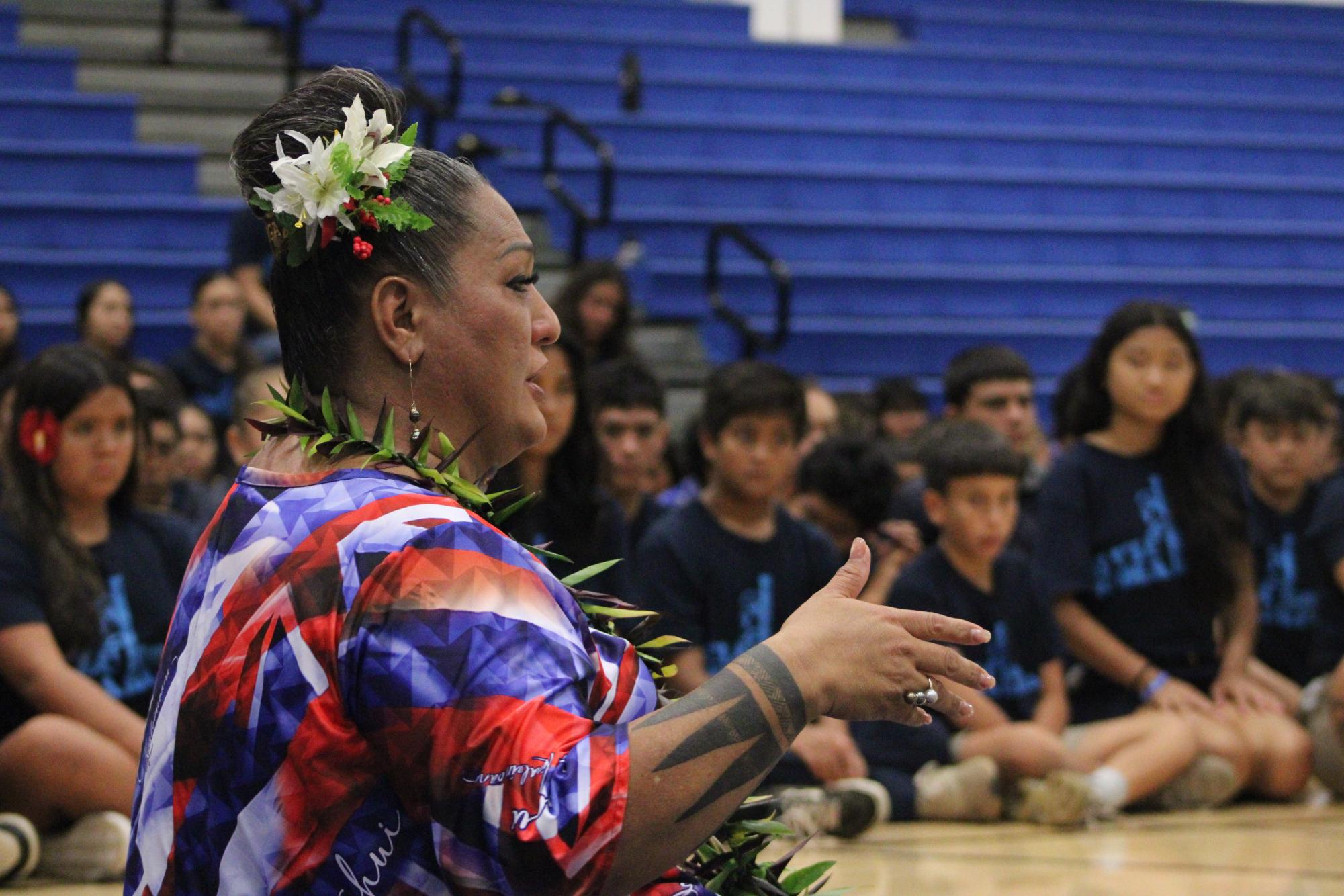
About the word māhū, Kumu Hina had this to say: “That word was used to hurt me. It no longer hurts me because I learned how to utilize my leo. It doesn’t hurt me because I learned about what being Kānaka means.”
“The word māhū is like the word haole. If we are speaking in our language, they are simply adjectives.”
Kumu Hina also talked about her experience in high school at KS Kapālama. She detailed how much Kamehameha has changed, noting that in the past, there was much less emphasis on mea Hawaiʻi.
Throughout her haʻiʻōlelo at Kaʻulaheanuiokamoku gym, she spoke about her identity, which she said is rooted in two things: ʻāina and moʻokūʻauhau.
She said, “Trust me, at Kapālama, I was not there. Kumu Hina was not Kumu Hina. Kumu Hina was Colin, and Colin didn’t know a darn thing until I started to take ʻōlelo, until I started to hīmeni, hoe waʻa and do all of these things.”
“Now,” she continued, “I know my language and culture, and now I am free to be me without any care in the world. When you look at somebody, it doesn’t matter if they are taller, shorter, wider, slimmer, however. Kāne, wahine, māhū, it doesn’t matter, because the most important things to our identity are moʻokūʻauhau and ʻāina.”
After her haʻiʻōlelo was finished, I had the privilege of speaking with Kumu Hina during lunch.
I asked how she manages to be so strong, despite other’s misguided opinions and thoughts about her, something I struggled with in the past.
She said, “When I stand in that room that we were in, or wherever I go, with whomever I go, I have to be centered all the time. So that nobody, not you, not anybody else at this table can move me off my center. So when I sit in and around other people, who can fly all other kinds of c**p at me, talk anything they want, I’m not bothered because their opinions are irrelevant to me. [They] don’t need to be by me, and my bun just gets higher.”
I already had some context of what it means to be māhū from watching Kapaemāhū, but I wanted to directly get Kumu Hina’s mana’o about what māhū means.
She elaborated, “The word is māhū, which [today] goes beyond what the understanding was in the time of our grandparents and great grandparents, [and now can describe more] specifically transgender issues. You could say ‘māhū haʻa kāne’ or ‘māhū haʻa wahine’ to mean in the manner of [a man or woman].”
“Take the papani ia. It means he/she/it. Does our culture have genitalia on the pronoun? No. So do I have to worry about what you think and what you say? No. Because at the end of the day, I’m still gonna be Hinaleimoana. And if you cannot acknowledge me by my name, you have a problem,” she continued.
Near the end of our kama’ilio, Kumu Hina said to me, “There were different stages of Kumu Hina. At one time, I thought I needed to be seen. I don’t have to be seen, but you will watch me. I don’t have to stop to take time to make someone see me. I’m just gonna do, and whether you like it or not, you’ll see me.”
I often hear the opinion that people like me wonʻt shut up about all that LGBTQ stuff, and maybe if everyone was cool about this topic and respected queer people for who we are, I would, but the fact is, according to the Williams Institute at UCLA’s School of Law, LGBTQ+ people are 5 times more likely to be victims of a violent crime. Trans Lives Matter reports that across the world, 367 trans people had their lives taken by violence or suicide from October 1st, 2024 to September 30th, 2025.
These are staggering numbers, and when you break down these statistics by ethnicity, people of color are much more likely to be victims.
It’s not within the scope of this work for me to get political, but I will say this: the perpetuation of anti-queer rhetoric will only further these statistics, and when attacks on gender-affirming care began ramping up, so did calls to the Trevor Project’s Suicide Hotline.
So, to anyone out there who feels alienated from our culture because of your queerness, I want you to know this: you are Hawaiian enough, you belong, and there is nothing wrong with you. You deserve to live a long, joyful life, one where you can realize, as Kumu Hina put it, “your amazing capacity for greatness.” So, stay grounded in this paeʻāina and your moʻokūʻauhau, and remain steady like ʻaʻaliʻi.
My name is Moss Limuakamokumekealoha Kuon. He māhū haʻa kāne au. And I will not be silenced.
Editor’s note: The views expressed in this article are the writer’s own and do not necessarily reflect the views of the staff or the school.





Kim Haina • Nov 30, 2025 at 4:16 pm
Hi, my name is Chip, I’m a gay black man, you don’t owe anything to anyone but yourself, so be yourself and find happiness. That is your only responsibility, so don’t worry be happy.
Chris Sugidono • Nov 28, 2025 at 9:30 pm
Mahalo for the wonderful and very powerful story (and on deadline!). You are a talented writer. Keep up the great work!
Kapulani Antonio • Nov 28, 2025 at 1:13 pm
E Limuakamomkumekealoha ē. Your leo is important not only for yourself, but for all the others who are struggling to find their place. Mahalo for sharing your moʻolelo.