

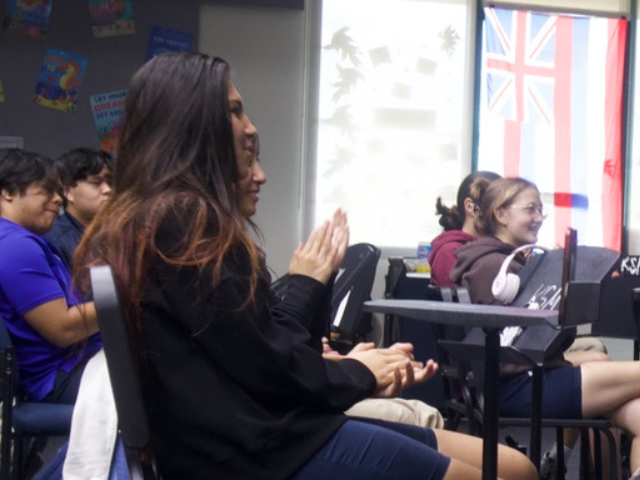
An unfamiliar yet captivating melody filled the band room, cutting through silence. It seemed as if outside that room, time had stopped. Frozen in awe, rows of students sat staring at the source of a wondrous sound — graceful and poised, a sleek violin bow sliced through the air, and the bellows of an accordion breathed with the intensity of instruments come to life.
After thunderous applause, Polish violinist Karolina Mikołajczyk and accordionist Iwo Jedynecki, known together as Duo Karolina & Iwo, rose and bowed after their private concert before a small group of students in the high school band room today.
They were fresh from an acclaimed performance at the Millennium Stage at The Kennedy Center in Washington, D.C. On a world tour throughout America, Europe, and Asia, this unique pairing of musicians brought a taste of the classics to Hawaiʻi.
A violin and accordion duo is rare, and in the classical world, it is almost unheard of, so such a combination provides the opportunity for new renditions and interpretations of classics.
“The joy of classical music is beautiful, and combining these two instruments together, it has so much to offer,” Mikołajczyk said.
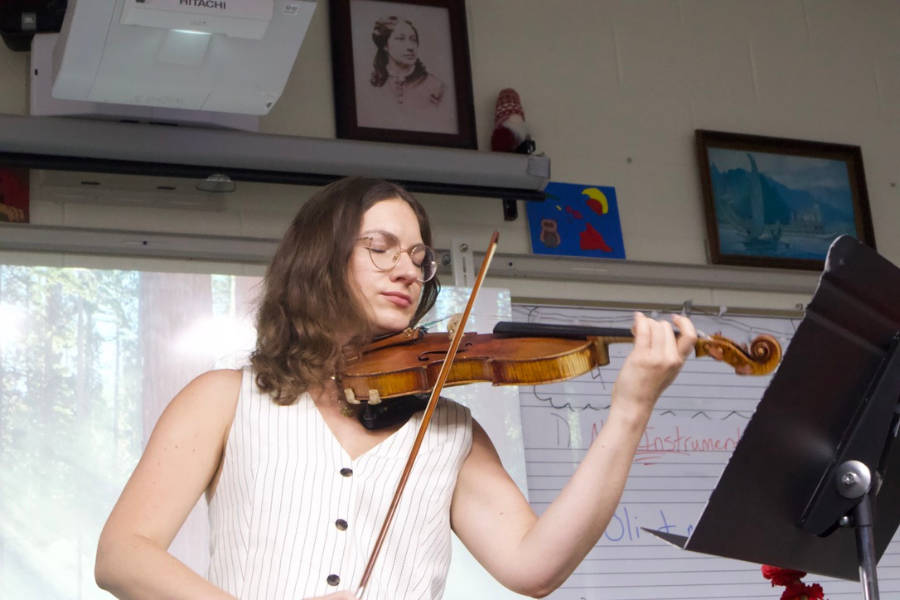
Karolina began playing the violin at the age of 4, as both her parents were musicians as well. Iwo began on the accordion at the age of 7, and they’ve both stuck with it ever since.
Now married, they met in college in 2011 and realized their instruments paired nicely together.
“We’ve played together for so many times, we don’t need lots of rehearsal time,” Mikołajczyk said. “We already know each other so well.”
Since their debut at the Warsaw Philharmonic, the duo has performed at prestigious venues such as Carnegie Hall (New York), Esplanade Concert Hall (Singapore), The Edge Melbourne (Australia), Teatro del Lago (Chile), and Guangzhou Opera House (China).
“Classical music has this capacity of moving, of pulling strings inside my heart, like no other music,” Iwo said. “What I want to have in our concerts is people will experience what I experience.”
Not only does the duo perform, they also have recorded four CDs: “Premiére” with original and self-arranged contemporary music for violin-accordion, “Orfeum Trio Plays Piazzolla, BŁAŻEWICZ” (nominated for the Fryderyk Prize – a Polish equivalent of a Grammy), and “IMAGIQUE: A Different History of Music.”
Just last year, in 2024, the duo won the most prestigious prize for classical music in Poland — the “Polityka Passport.”
“Because of classical music’s complexity and because of the fact that the greatest composers of all our history have music that has survived to this day — it’s what makes these pieces so unique and special,” Jedynecki said.
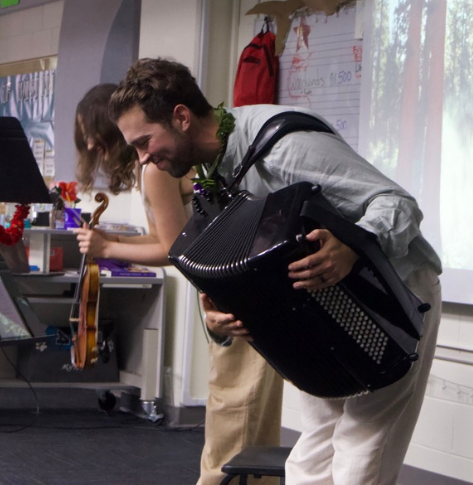
The duo started the concert by playing the anthem of their home country, Poland. Titled, “Mazurek Dabrowskiego,” this resolute, inspiring piece immediately caught the attention of the audience.
This was followed by a serene rendition of a French classic, Claude Debussy’s “Clair De Lune.”
Meaning “moonlight” in French, “Clair De Lune” was a favorite among the students. Although often heard on the piano, this piece paired the violin with the accordion beautifully.
Next, Duo played an amazing arrangement of Vivaldi’s “Winter.” Originally arranged for solo violin and orchestra, this rendition was skillfully adapted so that Karolina and Iwo played what would normally be the parts of an entire orchestra. This meant for the violin to play double stops — a technique that means playing two strings at the same time. In other words, she played two notes at once.
The accordion is a young instrument relative to others. The violin had been around for at least 300 years before its invention. Because of this, there aren’t many pre-existing arrangements or compositions specifically for an accordion, so “98% of the pieces that we play are our own arrangements,” Jedynecki explained.
For their fourth piece, Duo played six short, lively Romanian folk dances by composer Béla Bártok, each song transitioning seamlessly into the next.
Moving to the Americas, Karolina and Iwo played themes from George Gershwin’s “Porgy and Bess.” Incorporating styles of jazz, it was a fun and playful piece.
Next came a piece by Argentinian Astor Piazzola — “The Four Seasons of Buenos Aires.” Piazzola created the Nuevo tango genre, a style of tango that incorporates jazz and classical music with tango.
The last piece was Camille Saint-Saens’s “La Danse Macabre,” also known as “The Dance of the Dead.” Inspired by a poem by French poet Jean Lahor, this piece renders a ghostly image of a Parisian night, the dead entering the world of the living and dancing to their hearts content.
The Duo’s arrangement featured col legno, a violin bowing technique where the wooden part of the bow bounces off the strings, creating a percussive sound. The bouncing of the wooden bow sounded like the bones of the dead dancing.
Between the pieces, the musical duo shared anecdotes about their respective instruments. For example, Iwo showed the different parts of the accordion, and how, together, they can make interesting sounds. He demonstrated the use of the bass buttons, playing an entire chord with just one press of a button.
“The range of the accordion is as low as an E3 and even higher than the piano’s highest note,” he said as he demonstrated, first producing an earth-shakingly deep note, followed by almost a barely perceptible whistle. He also demonstrated how the buttons on the top of the accordion work — by playing them with his chin!
Out of all the famous venues that they’ve played at worldwide, Jedynecki explained why they took time from their tour to perform for a handful of students at a small high school on the island of Maui.
“We treat our concerts as concerts, but also some of them as educational opportunities, to share stories about our instruments and music in general,” he said. “We want to broaden the horizons of this world.”
For more information about Karolina and Iwo, check out their website. It’s in Polish, but their Nagrania tab features their YouTube videos in the universal language: music.


Susan K Antonio • Sep 16, 2025 at 10:15 am
Mahalo for sharing this story. I couldn’t make it but the excellent reporting puts me right in the room with you all.
Kim Haina • Sep 16, 2025 at 6:34 am
Found this article informative, highlighting musical instruments normally not paired. Also, expanding culture.
Mr.M • Sep 16, 2025 at 6:17 am
Wow.. That sounds like it was a great experience. Thanks for your article – it gave those of us that couldn’t attend a chance to get an idea of what it was like. Wish I could’ve seen and heard them play live.